Is Blood Falls Dangerous?
Blood Falls at Taylor Glacier in Antarctica attracts both scientists and explorers because of its extraordinary red appearance. The red color of its appearance stands out as one of Earth’s
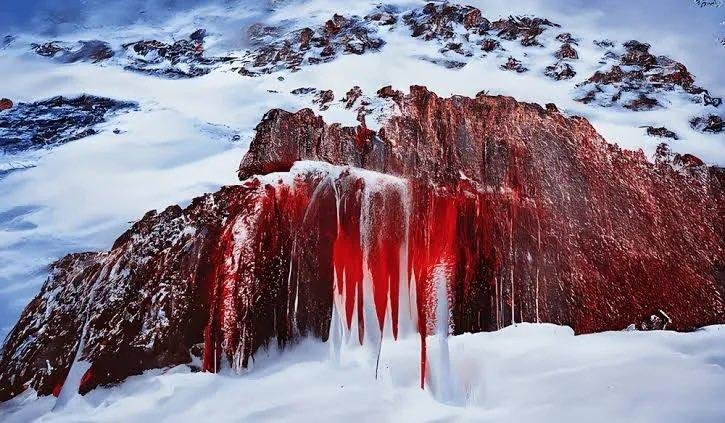
Blood Falls at Taylor Glacier in Antarctica attracts both scientists and explorers because of its extraordinary red appearance. The red color of its appearance stands out as one of Earth’s strangest visual phenomena. The process of subglacial lake water containing iron and high salt content flowing through ice leads to air exposure that triggers oxidation reactions, which simulate bleeding ice.
Blood Falls draws scientific interest because it contains an exclusive community of extremophile microorganisms that survive in complete darkness and without oxygen. Science teams have intensified their research about life beyond Earth by studying extreme environments because of this discovery. They now focus on icy moons such as Europa and Enceladus.
Scientific exploration of Blood Falls becomes highly difficult because its location in the extreme conditions of the McMurdo Dry Valleys makes it inaccessible to most visitors.
Specialized research missions with scientists make up the only group that visits this area because the extreme Antarctic conditions prevent recreational tourism from happening. The site presents no real hazards to those who manage to reach Blood Falls despite the bitter saline quality of its water, which cannot be consumed as drinking water.
The unique scientific value of Blood Falls makes it available to researchers mostly through their research missions in the Antarctic region.
Not only that, but it also raises the question if Blood Falls is dangerous or safe to visit. This guide helps to find out the proper answers to all your questions regarding Blood Falls at Taylor Glacier in Antarctica.
Table of Contents
ToggleBlood Falls at Taylor Glacier in Antarctica is an awe-inspiring yet eerie natural phenomenon that sparks curiosity and speculation. The deep red water seeping from the glacier’s surface gives the illusion of a bleeding ice sheet, leading many to question whether Blood Falls poses any danger.
However, despite its striking appearance, Blood Falls is not hazardous to humans or the surrounding environment. The reddish hue is simply the result of iron-rich, hypersaline water oxidizing when it comes into contact with air, creating a rust-like effect.
One of the most fascinating aspects of Blood Falls is the extreme environment from which it originates. The water emerging from Taylor Glacier is an ancient, subglacial brine, sealed away for over a million years. This water is incredibly salty—three times saltier than seawater—which prevents it from freezing despite Antarctica’s frigid temperatures.
Additionally, the isolated subglacial lake that feeds Blood Falls harbors microbial life that has adapted to survive without sunlight or oxygen. While these extremophiles are unique and resilient, they do not pose any biological threat to humans.
Although Blood Falls is safe to observe, its harsh conditions make it an inhospitable environment for human interaction. The extreme salinity and high iron content make the water undrinkable, and the freezing Antarctic temperatures pose a greater risk to explorers than the falls themselves.
Furthermore, due to its remote location within the McMurdo Dry Valleys, Blood Falls is not easily accessible. Scientists study it for its unique ecosystem and its potential parallels to extraterrestrial life, but no evidence suggests that it is dangerous to visit from a scientific or environmental standpoint.
The Blood Falls is located at Taylor Glacier in Antarctica. If you want to know more about Taylor Glacier, it is a glacier of about 54 Kilometers (34 miles) from the plateau of Victoria Land toward the western end of Taylor Valley. The area is north of the Kukri Hills and south of Asgard Range, with the middle part lying north of the Inland Forts and south of Beacon Valley.
Blood Falls, which is the outflow of saltwater tainted with iron oxide, giving a red color to the ice surface, is one of the most remarkable features of Taylor Glacier.
Taylor Glacier is accessed very harshly due to its remote location in the McMurdo Dry Valleys, one of the most extreme deserts on our planet. The nearest research stations are McMurdo Station and Scott Base on Ross Island. Any effort in getting to the glacier generally involves careful coordination with national Antarctic programs to use specialized aircraft or icebreaker vessels to transport personnel and equipment close to the glacier.
At that point, guided travel using tracked vehicles or helicopters will be taken on rough terrain. Environment sensitivity and logistical complications restrict the access generally to scientific personnel only conducting research within the area.
Blood Falls, in Antarctica, has been a cause for interest among scientists for more than 100 years because it is a striking waterfall, appearing to “bleed” and has red waters that traverse the Taylor Glacier. Unlike algae, which was once presumed to be the source of the eerie color, it’s an iron-rich subglacial brine, trapped by the ice for more than thousands of years, that now gives it this color.
The water ice-cut ancient reservoir does not allow any direct atmospheric contact and has very high iron and salt concentrations. As the brine seeps out of cracks in the glacier and reaches the surface, it undergoes a fascinating revelation in chemical transformation which imparts to Blood Falls its characteristic color.
Oxidation of its iron content causes this unique coloration similar to Blood Falls rusting. Oxidation of iron generally occurs when the iron-rich water meets the glacier surface and oxygen oxidizes the iron into iron oxides and gives it that deep red color. In this manner, one could see how iron rusts in the open air, too.
The newer research studies have uncovered very tiny iron-rich nanospheres, which add to the reddish appearance of the falls. It is possible to see the effect of “bleeding” from this brine despite the fact that Antarctica is practically always below freezing because of the very high salinity of the brine, which prevents it from freezing.
Blood Falls gives extraordinary science beyond its very good appearance; it will also shed light on ancient microbial life. This brine houses microorganisms that could flourish with sunlight or oxygen, having been in isolation for millions of years. This makes it an important location for astrobiologists, as it has valuable hints on how life might survive in extremely inhospitable places – on Mars or beneath the icy crusts of Jupiter’s moon Europa.
Life’s apparent tolerance beyond the planet adds an important dimension to what is now learned about Earth’s geological mysteries through the study of Blood Falls.
In the year 1911, the British geologist and explorer Thomas Griffith Taylor made his spectacular discovery in Antarctica: blood falls to Taylor Glacier. He was a member of the Terra Nova Expedition of Robert Falcon Scott and it was a scientific and exploratory mission to the Antarctic continent.
Walthamstow in England was the birthplace of Taylor, a fine geologist and glaciologist who really contributed to the early understanding of the geology of Antarctica. Such a striking contrast of red flow from the edge of a glacier instead of the white ice and rocky terrain of the surrounding valley was observed during his venture through the remote and desolate area of the McMurdo Dry Valleys.
This is the kind of phenomenon: a Hollow “blood” waterfall that has never been seen before or experienced; curiosity and scientific investigation have continued till today.
At the time of his discovery, Taylor and his team initially speculated that the red coloration of Blood Falls might be due to red algae or some organic matter. But then, later studies contradicted the idea and revealed a much more complex geochemical mechanism was at work. Water from Blood Falls seeps from a subglacial hypersaline lake that has remained in confinement under the thick ice of Taylor Glacier for millions of years.
The brine here is rich in iron, and as the water reaches the glacier surface and touches oxygen, then the oxidation of iron occurs-rusting of sorts-dyeing the outflow a deep shade of red. Moreover, the brine’s high salt concentration prevents its freezing, thus allowing it to seep ceaselessly down through cracks in the ice and along the glacier, even during the bitter cold weather conditions of Antarctica.
Blood Falls at Taylor Glacier has not only been visually fascinating but has also stood as a scientific discovery. Over the years, researchers have reported on the presence of microbial life thriving, completely hidden from light, without oxygen, and under high salinity levels, in the subglacial lake on which Blood Falls is fed.
These extremophiles have adapted to some of the most inhospitable environments on Earth and may provide insight into how life could be found in extraterrestrial environments, as may be the case on Mars or the icy moons of Jupiter and Saturn.
Today, the discovery of Taylor continues to inspire scientists as Blood Falls serves as the latest portal or window into ancient closed ecosystems and the endurance of life in harsh environments. Indeed, this red waterfall ranks among the most mysterious natural wonders of Antarctica, reminding most of the early wonderment and devotion on the part of Thomas Griffith Taylor.
Blood Falls, in Antarctica, has been a cause for interest among scientists for more than 100 years because it is a striking waterfall, appearing to “bleed” and has red waters that traverse the Taylor Glacier. Unlike algae, which was once presumed to be the source of the eerie color, it’s an iron-rich subglacial brine, trapped by the ice for more than thousands of years, that now gives it this color.
The water ice-cut ancient reservoir does not allow any direct atmospheric contact and has very high iron and salt concentrations. As the brine seeps out of cracks in the glacier and reaches the surface, it undergoes a fascinating revelation in chemical transformation which imparts to Blood Falls its characteristic color.
Oxidation of its iron content causes this unique coloration similar to Blood Falls rusting. Oxidation of iron generally occurs when the iron-rich water meets the glacier surface and oxygen oxidizes the iron into iron oxides and gives it that deep red color. In this manner, one could see how iron rusts in the open air, too.
The newer research studies have uncovered very tiny iron-rich nanospheres, which add to the reddish appearance of the falls. It is possible to see the effect of “bleeding” from this brine despite the fact that Antarctica is practically always below freezing because of the very high salinity of the brine, which prevents it from freezing.
Blood Falls gives extraordinary science beyond its very good appearance; it will also shed light on ancient microbial life. This brine houses microorganisms that could flourish with sunlight or oxygen, having been in isolation for millions of years.
This makes it an important location for astrobiologists, as it has valuable hints on how life might survive in extremely inhospitable places – on Mars or beneath the icy crusts of Jupiter’s moon Europa. Life’s apparent tolerance beyond the planet adds an important dimension to what is now learned about Earth’s geological mysteries through the study of Blood Falls.
Blood Falls at Taylor Glacier is a fascinating sight to behold. The deep crimson waterfall is difficult to observe due to its remote positioning and great environmental management of the whole continent. Access to Blood Falls is limited to a few scientific researchers working out of nearby stations such as McMurdo Station and Scott Base. Tourists rarely visit this particular site since it’s far from the usual tourist routes in Antarctica.
For those few tourists who contemplate trying to get there, the whole process would require travel on specialized expeditions that provide routes through the Ross Sea and special permits must be obtained to get into the McMurdo Dry Valleys.
Although tourists would never get close, it would be quite necessary for research stations to helicopter the last leg to Blood Falls because of the challenging terrain and nonexistent infrastructure. However, such tourism experiences are extremely rare, if not nonexistent, because of the environmental and logistical complexities involved.
Strict protocol compliance is mandatory in Antarctica, where the environment is quite sensitive and hazardous. Visitors must minimize their ecological impacts by not disturbing the pristine landscape. First though, safety; because of the harshness of the environment, the unpredictable state of the weather, and the isolation, careful preparation plus specialized equipment and contingency plans must all be undertaken.
Further, any potential visitor should know that any mistake has dire consequences on the part of personal safety and the fragile ecosystem found here. Hence, inviting as it may be to see Blood Falls, the logistical and responsibility burdens make such visits impractical for generalized tourism.
Blood Falls at Taylor Glacier are unusually red and remain in constant flow throughout the year, albeit with slight seasonal changes in Antarctica. The basic system of Blood Falls, however, can fundamentally change in terms of its environment and accessibility. Let us see how the falls and the region change through each season.
Temperatures in Antarctica are mildest during summer, often rising to around -2°C (28°F) at places such as McMurdo Sound, and this is when it becomes a hub of scientific activity and research activity for everyone concerned. The ideal time to watch the Falls, really, because there isn’t even a nightfall at that time-the brightest sun shines all day long-would really be this time of the year.
Bright light makes the waterfall’s striking red color much more vivid, and, indeed, the water still flows down. The periphery of the poles has milder conditions and although not easy, provides the most favorable opportunity for scientists and rare carefully coordinated tourism visitors to the site, usually by helicopter. The falls are striking at this moment, really beautiful against the harsh whiteness surrounding everything.
With the arrival of autumn, the temperature starts to fall, and along with it dwindling daylight hours. This is also a time when temperatures can go down to the freezing point, and the rigors of the environment increasingly begin to take a toll on the accessibilities that will be permitted. The flow should be constant during autumn at Blood Falls, but the area becomes increasingly difficult to access with travel-worsening weather.
The actual appearance of the falls does not change but the freezing and hardening of ice and snow in the surrounding landscape offer a quieter and more isolated atmosphere. Therefore, the diminishing daylight hours compel researchers to plan carefully and work within limited hours of sunlight.
Winter in Antarctica isn’t something worth looking forward to; it’s usually frozen in and around 50 degrees Celsius (-58 degrees Fahrenheit) in places like around the Taylor Glacier. For that matter, there will be months when daylight will not be seen on that continent, making fieldwork and observation nearly impossible. But Blood Falls still runs all through because subterranean pressure and salinity of the brine keep it liquid no matter how cold it gets up there.
The falls are practically invisible from the surface, thanks to a complete lack of daylight, and very dangerous and rare research or site access would be provided. The areas are well off for most except for the trickiest prepared research expeditions that are to endure extreme conditions.
With the slowly rising temperature and the return of sunlight, it is usually late in spring. This transitional time of year also hinges on the south before the Australian summer. Blood Falls will very soon start to thaw also. In water flow, it remains constant; outside surrounding ice, however, will start cracking and shifting, drawing new fissures and other features around the falls.
Spring makes access to the Falls quite easier, but it does not guarantee warm temperatures. Weather conditions remain cold, with quite a bit of variability. This is actually the time when most researchers start underfield again, making use of the returning light and thawing conditions outside.
Blood Falls is a fascinating natural event that reveals itself in Antarctica’s McMurdo Dry Valleys, where iron-rich, hypersaline water flows from the Taylor Glacier, leaving brilliant red stains on the ice. The locale of Blood Falls is very remote and is heavily protected by the environment, making it extremely challenging for access, which is usually limited to scientific researchers.
Owing to this very reason, no commercial tours exist to take interested tourists directly to Blood Falls.
Travelers may explore some of the other incredible features of the Antarctic region through various expedition options. Here is an extensive guide to planning any possible expedition to Antarctica, including the costs involved.
Related Story: How To Reach Jewel Cave?
Blood Falls at Taylor Glacier in Antarctica attracts both scientists and explorers because of its extraordinary red appearance. The red color of its appearance stands out as one of Earth’s

Has anyone ever thought of exploring Amsterdam in 2 days and 3 days? Amsterdam has multiple reasons to be explored by global visitors, thanks to its lively canals, wonderful history,
Planning a trip to Amsterdam? Explore the best time to visit based on weather, tulip season, canal views, festivals, crowd levels, and budget. Find the perfect season for your ideal Amsterdam travel experience.

Explore the best family vacations and trips worldwide. Hike Globally offers trusted guides and tips for unforgettable adventures with your loved ones.
Copyright ©2026 | Hike Globally | All Rights Reserved.
Made with ❤️ by Growlith Academy