Pashupatinath Temple Nepal: History, Age & How to Reach
Pashupatinath Temple stands as Nepal’s most important Hindu temple dedicated to Lord Shiva and one of the most sacred pilgrimage sites in South Asia. Located on the banks of the Bagmati River in Kathmandu, the temple attracts Hindu devotees, spiritual travelers, and first-time family visitors seekin...
Pashupatinath Temple stands as Nepal’s most important Hindu temple dedicated to Lord Shiva and one of the most sacred pilgrimage sites in South Asia. Located on the banks of the Bagmati River in Kathmandu, the temple attracts Hindu devotees, spiritual travelers, and first-time family visitors seeking cultural understanding beyond standard sightseeing. Many travelers search for the temple’s history, sacred Shivling, religious rituals, and practical information before visiting because the experience feels deeply spiritual, emotionally intense, and culturally unfamiliar.
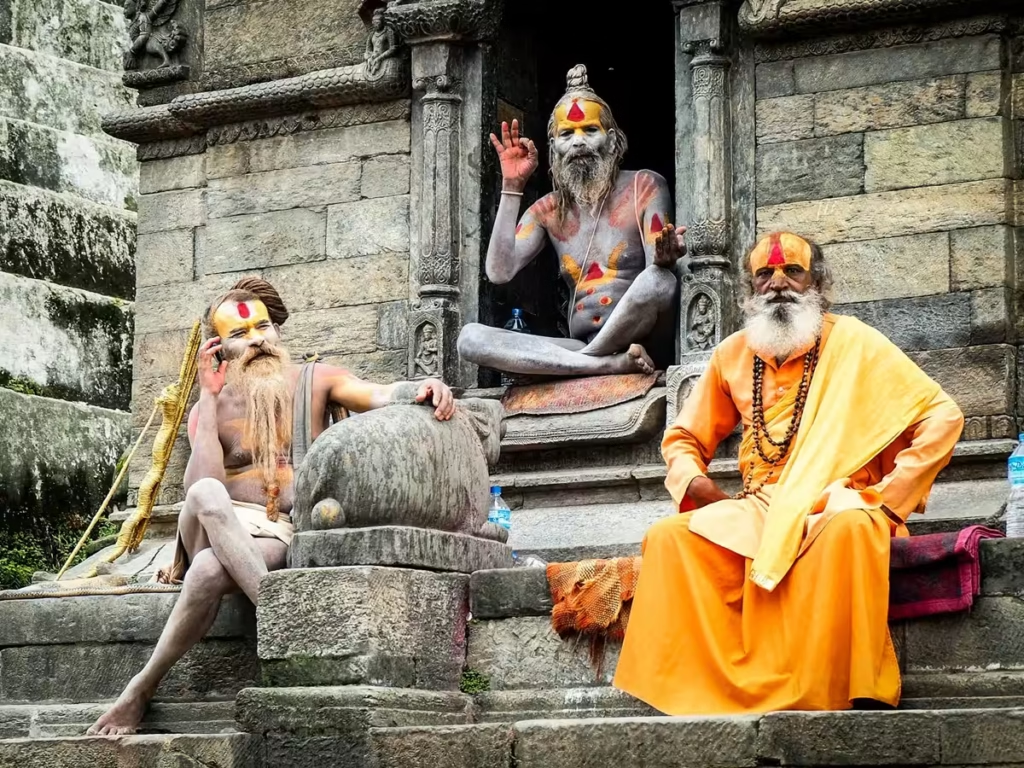
Families visiting Pashupatinath Temple often worry about cremation ceremonies, temple restrictions, crowd safety, aggressive photography requests, and confusion about Hindu rituals. These concerns remain valid. The temple complex includes active funeral ghats where Hindu cremation rituals take place daily beside the sacred Bagmati River. Visitors who arrive unprepared often make cultural mistakes such as photographing grieving families, entering restricted areas, or misunderstanding the role of sadhus and temple priests.
Pashupatinath Temple also carries enormous religious significance in Shaivism traditions. The temple houses a sacred four-faced Shivling representing Lord Shiva as Pashupati, meaning “Lord of All Living Beings.” Although non-Hindus cannot enter the main sanctum, they still access much of the surrounding complex, riverfront viewpoints, shrines, and spiritual landmarks.
This guide explains the history, age, Shivling significance, temple location, entry rules, costs, safety concerns, and the best ways to reach Pashupatinath Temple from Kathmandu and Tribhuvan International Airport.
Pashupatinath Temple holds recognition as Nepal’s most sacred Lord Shiva temple and serves as the primary center of Shaivism worship in the Kathmandu Valley. The temple draws global attention for three interconnected reasons: its ancient Shivling housed inside the main sanctum, the open-air cremation ghats along the Bagmati River where Hindu funeral rites occur daily, and its designation as a UNESCO World Heritage Site since 1979. Families researching “famous Shiva temple Nepal” find Pashupatinath consistently ranked as the country’s most spiritually significant Hindu pilgrimage destination.
The complex functions simultaneously as an active religious site and a cultural monument, which creates practical challenges many guidebooks gloss over. Visitors witness real grief, real devotion, and real death—not a sanitized tourist experience. First-time travelers often arrive expecting a quiet historical monument and instead encounter crowds of pilgrims, the smell of incense mixed with cremation smoke, and intense religious activity that can feel overwhelming, especially for children.
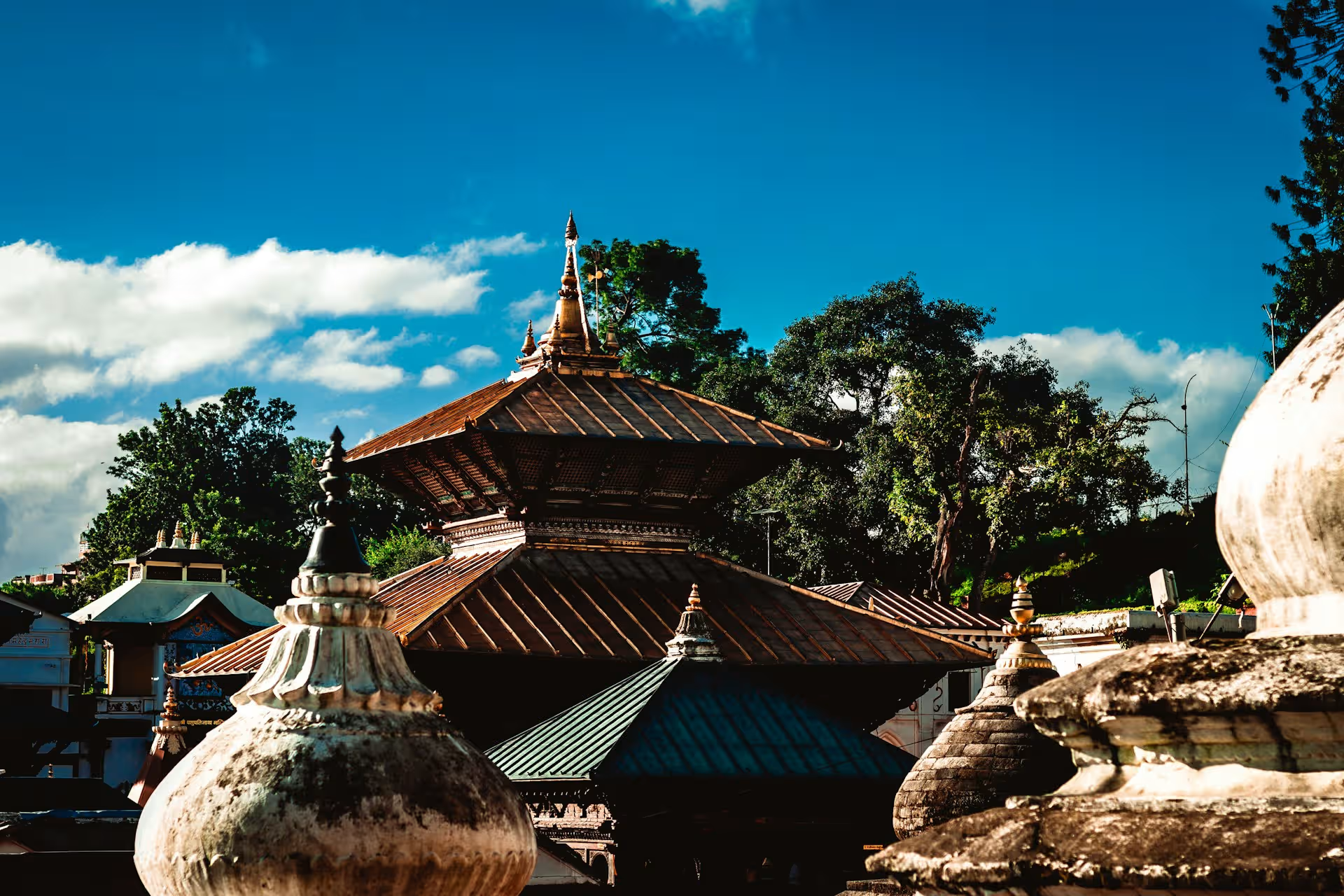
Non-Hindus cannot enter the main temple’s inner sanctum, a restriction that surprises many Western families who assume their entry ticket grants full access. You observe the gilded pagoda roof and carved doorways from the eastern courtyard, while Hindu devotees queue for darshan of the sacred Shivling. This partial-access arrangement frustrates some visitors, but it protects the temple’s primary function as a living place of worship rather than a museum.
The temple stays famous precisely because it prioritizes religious authenticity over tourist convenience, making it spiritually powerful but requiring cultural sensitivity and emotional preparation.
Religious Importance of Lord Shiva at Pashupatinath
Hindus revere Lord Pashupati as a manifestation of Shiva in his role as “Lord of All Creatures” (pashu meaning animals or beings, pati meaning lord). This protective aspect differentiates Pashupatinath from other Shiva temples that emphasize destruction, meditation, or cosmic dance. Devotees believe Pashupati watches over all living beings—humans, animals, and nature—making the deity particularly significant in Nepal, where animism blends with Hindu practice. Families notice the numerous monkeys, stray dogs, and cows wandering the temple grounds; locals consider these animals sacred residents under Pashupati’s protection, not pests to avoid.
The worship here connects to ancient pastoral traditions where communities sought divine protection for their livestock and families. Pilgrims bring offerings of milk, honey, bilva leaves, and flowers directly associated with Shiva worship, and they perform pradakshina (circumambulation) around secondary shrines even when they cannot access the main sanctum. Many first-time visitors misunderstand the crowds and assume it’s “just busy,” but the density reflects genuine devotion—people travel days from rural Nepal and northern India specifically for Pashupati’s darshan.
The temple’s religious importance intensifies during Maha Shivaratri, when hundreds of thousands of pilgrims converge on the site. Families visiting during this February-March festival face extreme crowds, overnight queues, and sadhus openly using cannabis as religious practice. The experience becomes spiritually intense but logistically chaotic, and the festival atmosphere includes both deep devotion and rowdy behavior. If you want to understand Pashupati’s significance, observing Shivaratri shows the deity’s living cultural power, but families with young children often find the scale and intensity unmanageable.
Importance of the sacred Shivling inside the temple
The Shivling at Pashupatinath Temple represents one of the most revered Shiva lingams in South Asia, and devotees consider it a swayambhu (self-manifested) sacred form rather than a human-made sculpture. The lingam features four faces visible from cardinal directions, with a fifth face pointing upward—this panchamukhi (five-faced) design symbolizes Shiva’s omnipresence and his aspects as creator, preserver, destroyer, concealer, and revealer. Only Hindu worshippers access the inner sanctum where priests perform abhishekam (ritual bathing) of the lingam with water, milk, yogurt, honey, and ghee multiple times daily.
The sanctity of this particular Shivling connects to several origin legends, though historians cannot verify most claims. The most common narrative describes a divine light manifesting at this Bagmati River location, which Shiva devotees recognized as the deity’s presence. Whether you believe the legends or not, the Shivling’s religious power comes from centuries of continuous worship and the concentrated devotion of millions of pilgrims. Non-Hindu visitors sometimes dismiss the lingam as “just a stone,” missing the theological sophistication: the abstract form represents the formless divine made accessible to human devotion.
You can observe priests carrying offerings inside and devotees receiving prasad and tilak afterward, which provides indirect participation. Many travelers feel disappointed by this exclusion, but respecting these boundaries demonstrates cultural maturity and helps preserve the temple’s religious integrity rather than reducing it to a photo opportunity.
Cremation rituals along the Bagmati River
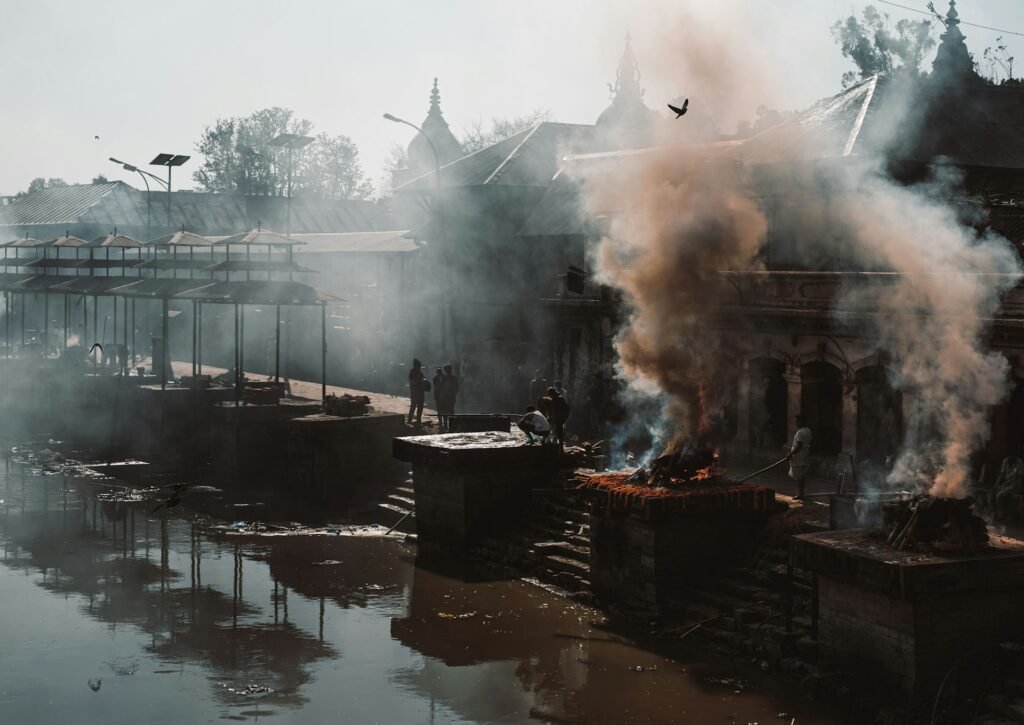
The Bagmati River serves as Pashupatinath Temple’s spiritual artery, and the riverside cremation ghats function as Nepal’s most sacred site for Hindu funeral rites. Families witness open-air cremations on raised platforms where bodies burn on wood pyres for several hours while relatives perform prescribed rituals. The cremation process follows specific protocols: the eldest son typically lights the pyre, circling the body while priests chant mantras, and family members shave their heads and wear white as mourning symbols. After cremation, attendants sweep ashes and bone fragments directly into the river, which Hindus believe carries the deceased’s remains toward the sacred Ganges River system.
The spiritual significance of Bagmati cremations connects to Hindu beliefs about moksha (liberation from the rebirth cycle). Devotees consider death at Pashupatinath, followed by proper cremation rites beside Lord Pashupati’s temple, as exceptionally auspicious for the soul’s journey. This belief brings families from across Nepal and India, sometimes traveling for days with a deceased relative’s body to reach these specific ghats. You often witness elderly pilgrims who come to Pashupatinath specifically to die here, staying in nearby dharamshalas (pilgrim rest houses) during their final days.
The constant presence of cremations surprises first-time visitors who arrive expecting an empty historical site. On average, several cremations occur simultaneously throughout the day, and the smoke, smell, and visible flames create an atmosphere unlike typical tourist destinations. The rawness confronts visitors with mortality in ways Western cultures typically avoid, making Pashupatinath simultaneously profound and deeply uncomfortable for many families.
Cultural etiquette families must follow near cremation ghats
Cultural etiquette at the cremation ghats centers on one principle: recognize you’re witnessing real grief, not a cultural show. Never photograph cremations, cremation platforms, or grieving families, even from a distance or with a telephoto lens. Locals notice discreet phone photography, and it generates genuine anger from mourners and temple attendants. Several online travel forums report visitors being confronted, yelled at, or having phones grabbed for this violation. The prohibition extends to video recording, and yes, this means you cannot capture the “atmospheric” smoke or flames for your travel vlog.
Maintain respectful distance from active cremation platforms, particularly the VIP ghats reserved for royal family members and high-status individuals. You can observe from the opposite riverbank or the raised terraces designed for viewing, but don’t approach burning pyres closely or linger directly in front of mourning families. Dress conservatively—shoulders and knees covered minimum—and remove hats and sunglasses when near active ceremonies. Loud conversations, laughing, eating, or drinking near cremations all violate basic respect, though you see tourists doing this regularly.
Children need specific preparation and supervision. Explain what they’ll witness before arriving, using age-appropriate language about Hindu death beliefs. Hold young children’s hands to prevent them from wandering near dangerous areas like riverbanks or active pyres. Older children should leave phones in bags to remove temptation, and families should establish a signal for when someone feels overwhelmed and needs to leave. Many families find the experience meaningful, but it requires treating the ghats as sacred space rather than a tourist attraction, which demands behavioral standards most casual sightseeing doesn’t require.
Ancient carvings, shrines, and monasteries inside the complex
The Pashupatinath Temple complex extends far beyond the main temple, encompassing over 500 smaller temples, shrines, statues, and inscriptions scattered across both riverbanks. Ancient stone carvings dating from the Licchavi period (400-750 CE) survive in protected areas, though many original artworks suffered damage during the 2015 earthquake. The most significant carvings include multi-armed deity images, Shiva lingams in various sizes, and inscriptional stones documenting royal donations and religious endowments that help historians date different construction phases.
Secondary shrines dedicated to related deities create a complete Hindu theological landscape. The Guhyeshwari Temple, located nearby, honors Shakti and completes the symbolic pairing of Shiva and his consort. The Gorakhnath Temple represents ascetic Shaivite traditions, while numerous smaller Ganesh, Hanuman, and goddess shrines serve devotees’ specific needs. First-time visitors often miss these secondary sites by focusing only on the main temple, but the broader complex reveals Hindu practice’s diversity where multiple deities, philosophies, and ritual traditions coexist within one sacred geography.
The monasteries (mathas) and pilgrim rest houses surrounding the temple demonstrate how major pilgrimage sites function as complete communities, not just individual buildings. These structures house resident priests, visiting sadhus, pilgrims, and religious scholars, creating a permanent population dedicated to the site’s spiritual life. Many buildings show neglect and earthquake damage, and some areas look more like slums than World Heritage sites, reflecting the reality that heritage conservation competes with basic maintenance needs. Families exploring beyond the main courtyard discover this complex social ecology but should stay aware that not all areas welcome casual tourists, and some zones remain too poorly maintained for safe exploration with children.
How to Reach Pashupatinath Temple
Travelers reach Pashupatinath Temple easily from central Kathmandu and Tribhuvan International Airport by taxi, ride-share apps, or guided tours. The temple sits approximately 5 kilometers east of Thamel (Kathmandu’s main tourist district) and 6 kilometers from the airport, making it accessible within 20-40 minutes depending on traffic conditions. Most families choose private transport over public buses because navigating Kathmandu’s chaotic road system with luggage or young children adds unnecessary stress to an already overwhelming first-day experience in Nepal.
Best Routes From Tribhuvan International Airport
Tribhuvan International Airport sits 6 kilometers west of Pashupatinath Temple, and the most direct route follows Ring Road eastward through Koteshwor junction before turning north toward the temple entrance. This journey covers approximately 6-7 kilometers but varies significantly based on which terminal you depart from (domestic or international) and current road construction projects that frequently reroute traffic without warning. Google Maps provides routing, but drivers often take alternate routes through residential neighborhoods to avoid Ring Road congestion, especially during morning (7-10 AM) and evening (4-7 PM) rush hours.
Travel time ranges wildly from 20 minutes in light traffic to 90 minutes during peak congestion, and first-time visitors consistently underestimate this variability. Early morning flights arriving at 6 AM reach the temple quickly, while afternoon arrivals around 4-5 PM hit maximum traffic when the entire city seems gridlocked. The route passes through Koteshwor, one of Kathmandu’s most congested intersections, where traffic police manually direct vehicles and delays extend 15-20 minutes regularly. Families arriving during Dashain or Tihar festivals face even worse conditions as local holiday traffic compounds tourist volumes.
Taxi pricing from the airport operates on two systems: prepaid airport taxi counters inside the terminal charge fixed rates around NPR 1,000-1,200 (approximately USD 7.50-9), while ride-sharing apps like Pathao or InDriver quote NPR 600-800 for the same journey. The price difference reflects airport taxi monopoly pricing rather than service quality—both options use similar vehicles and drivers. Airport taxi counters pressure arriving passengers to book immediately, claiming ride-share apps “don’t work” or “aren’t safe,” which stays false but effectively scares jet-lagged travelers into overpaying.
The most common pricing mistake involves accepting non-metered taxis at inflated rates. Some drivers quote NPR 2,000-3,000 for airport-to-temple transfers, targeting exhausted families who don’t know local rates. Always insist on the meter (“meter chalaunus” in Nepali) or book through apps with transparent pricing. If you’ve pre-arranged hotel pickup, confirm whether the driver knows Pashupatinath’s main entrance versus service gates—miscommunication deposits families at wrong locations requiring additional walking through confusing temple perimeter areas.
Public Transport vs Taxi vs Private Driver
Families generally prefer taxis or private drivers over public transport when visiting Pashupatinath Temple, primarily because local microbuses (tempos) and standard buses don’t accommodate luggage, operate on confusing routes, and involve multiple transfers that turn a simple 6-kilometer journey into a 90-minute ordeal. Public buses from Ratna Park or New Bus Park do serve areas near the temple, but you’ll still walk 10-15 minutes from bus stops while navigating through markets, traffic, and narrow pedestrian paths unsuitable for families with young children or elderly members.
Taxis offer the practical middle ground for single temple visits—you pay NPR 600-800 from Thamel using ride-share apps, avoid the hassle of vehicle rental, and don’t commit to multi-hour private driver rates. However, taxis create return-trip challenges because few drivers wait at the temple, and finding return transport during peak hours involves competing with other tourists and pilgrims for limited vehicles. The temple area lacks organized taxi stands, so you’ll negotiate with random drivers who quote inflated prices to trapped customers. Private drivers charging NPR 3,000-4,000 for half-day service (4-5 hours) make sense for families visiting multiple sites or those wanting guaranteed return transport without negotiation stress.
Safety concerns during peak hours center less on crime and more on traffic accidents and overwhelming crowds. Kathmandu drivers operate aggressively, and intersections near Pashupatinath become chaotic during festivals when normal traffic rules collapse entirely. Families with children crossing roads near the temple face genuine danger from speeding motorcycles, impatient buses, and the absence of functional traffic signals or pedestrian infrastructure. Inside the temple complex during Shivaratri or major festivals, crowd crush becomes a real risk—thousands of pilgrims push through narrow gates and bridges, and children can easily become separated or trampled.
Inexperienced travelers consistently underestimate Kathmandu traffic delays because Google Maps shows 20-minute best journeys that actually require 45-60 minutes during normal conditions. The city lacks functional public transit, suffers from constant road construction, and concentrates vehicle volumes on inadequate roads built for one-tenth current traffic. Earthquakes damaged road infrastructure that remains partially repaired, creating bottlenecks where four lanes merge into one without warning. First-time visitors scheduling tight itineraries—temple visit at 9 AM, next activity at 11 AM—find themselves still stuck in traffic when the second appointment arrives, triggering cascading delays throughout their day.
Best Hours/Time to Visit the Temple
Morning visits between 6-9 AM offer significant advantages: smaller crowds, cooler temperatures, active morning aarti ceremonies, and better air quality before vehicle emissions accumulate. The main aarti occurs around 6 AM when priests perform elaborate worship rituals with bells, incense, and fire offerings that create the temple’s most atmospheric moments. Arriving at dawn means you witness genuine devotional practice rather than tourist-hour chaos, though this timing requires overcoming jet lag and arranging early transport when most drivers prefer starting after 7 AM.
Crowd levels remain manageable on regular weekdays, increase notably on Mondays (Shiva’s auspicious day), and become completely overwhelming during Maha Shivaratri in February-March when 500,000+ pilgrims converge on the complex. Families visiting during Shivaratri encounter 2-3 hour queues just to enter, aggressive crowds around the main temple, and thousands of sadhus and devotees creating an intense atmosphere beautiful in its devotion but physically challenging for children and claustrophobic adults. If you want to experience Shivaratri’s power, arrive the day before the main festival when crowds build but remain navigable, or accept that the festival day itself requires patience, physical stamina, and comfort with extreme crowding.
Air pollution significantly impacts temple visits, particularly during winter months (November-February) when Kathmandu Valley’s infamous smog reaches hazardous levels. Morning visits before 10 AM show relatively clear air, but afternoons often disappear into gray haze that obscures views, irritates throats, and makes photography disappointing. Seasonal visibility concerns intensify during pre-monsoon months (March-May) when dust combines with pollution, versus post-monsoon clarity (October-November) when Himalayan views appear from higher temple terraces. Families with asthma or respiratory sensitivities should carry masks and consider avoiding winter visits when AQI readings frequently exceed 200 (very unhealthy levels).
Entry Fees, Timings, and Security Checks
Current entry policies charge foreigners NPR 1,000 (approximately USD 7.50) per person at the main gate, while SAARC nationals pay NPR 100 and Nepali citizens enter free. Children under 10 typically receive free entry, though enforcement varies and some ticket checkers charge regardless of age—keep small bills ready because change availability stays unreliable. The ticket booth accepts only Nepali rupees in cash; no cards, no foreign currency, and the nearest ATM sits 10 minutes’ walk outside the complex. This cash-only policy catches unprepared visitors regularly, forcing backtracking to find money changers who offer poor exchange rates knowing customers have no alternatives.
Temple opening hours officially run from 4 AM to 7 PM daily, but practical visiting hours fall between 5 AM and 6 PM when adequate light allows safe navigation and photography. The main sanctum remains open throughout these hours for Hindu devotees, while non-Hindu visitors access only outer courtyards and riverbank terraces regardless of timing. Evening visits lose visual appeal as poor lighting makes the complex difficult to navigate and photography nearly impossible without tripods and long exposures—most families prefer morning or midday visits despite larger crowds.
Security checks at entrance gates involve basic bag inspections, metal detectors that work intermittently, and prohibited item lists including leather goods (shoes, belts, bags), alcohol, meat products, and large backpacks. Guards enforce the leather prohibition strictly because Hindu tradition considers cow leather defiling in sacred spaces, and they’ll turn away visitors wearing leather belts or carrying leather purses. This restriction surprises Western tourists who don’t consider everyday leather accessories as religious violations. The temple provides bag storage lockers near the entrance, but they’re small, poorly maintained, and charge nominal fees that guards sometimes pocket without providing receipts.
Security concerns include pickpocketing in crowded areas, aggressive donation requests from supposed temple officials (actual priests rarely approach tourists directly), and photography restrictions near cremation ghats and inner sanctums. Guards and self-appointed “guides” sometimes demand bribes or fees for made-up violations, targeting confused foreign visitors who can’t distinguish legitimate rules from scams. Families should keep valuables secure, avoid displaying expensive cameras unnecessarily, and politely but firmly refuse unsolicited guide services at the entrance—legitimate guides arranged through hotels or licensed tour companies, not through aggressive touts at temple gates.
Nepal will offer several beginner-friendly summer treks that families can complete safely with proper pacing and preparation. The best options will combine lower altitude, reliable accommodation, manageable walking hours, and
Pashupatinath Temple stands as Nepal’s most important Hindu temple dedicated to Lord Shiva and one of the most sacred pilgrimage sites in South Asia. Located on the banks of the
Known as the ‘Land of Eternal Spring,’ Guatemala is a haven for global travelers. However, it does not mean that the country has a Spring-like climate all round the year.
To provide the best experiences, we use technologies like cookies to store and/or access device information. Consenting to these technologies will allow us to process data such as browsing behavior or unique IDs on this site. Not consenting or withdrawing consent, may adversely affect certain features and functions.
Functional
Always active
The technical storage or access is strictly necessary for the legitimate purpose of enabling the use of a specific service explicitly requested by the subscriber or user, or for the sole purpose of carrying out the transmission of a communication over an electronic communications network.
Preferences
The technical storage or access is necessary for the legitimate purpose of storing preferences that are not requested by the subscriber or user.
Statistics
The technical storage or access that is used exclusively for statistical purposes.The technical storage or access that is used exclusively for anonymous statistical purposes. Without a subpoena, voluntary compliance on the part of your Internet Service Provider, or additional records from a third party, information stored or retrieved for this purpose alone cannot usually be used to identify you.
Marketing
The technical storage or access is required to create user profiles to send advertising, or to track the user on a website or across several websites for similar marketing purposes.